


Environmental Plastic Exposure May Promote Early-Onset Breast Cancer Through Metabolic Changes
In this study, researchers focused on a commonly used plasticizer called di(2-ethylhexyl)phthalate (DEHP), a chemical found in many consumer products and known to act as an endocrine disruptor. By analyzing patient samples, the team observed that higher levels of DEHP exposure were associated with earlier breast cancer diagnosis. This observation raised an important question: how might an environmental chemical influence tumor behavior at the cellular level?
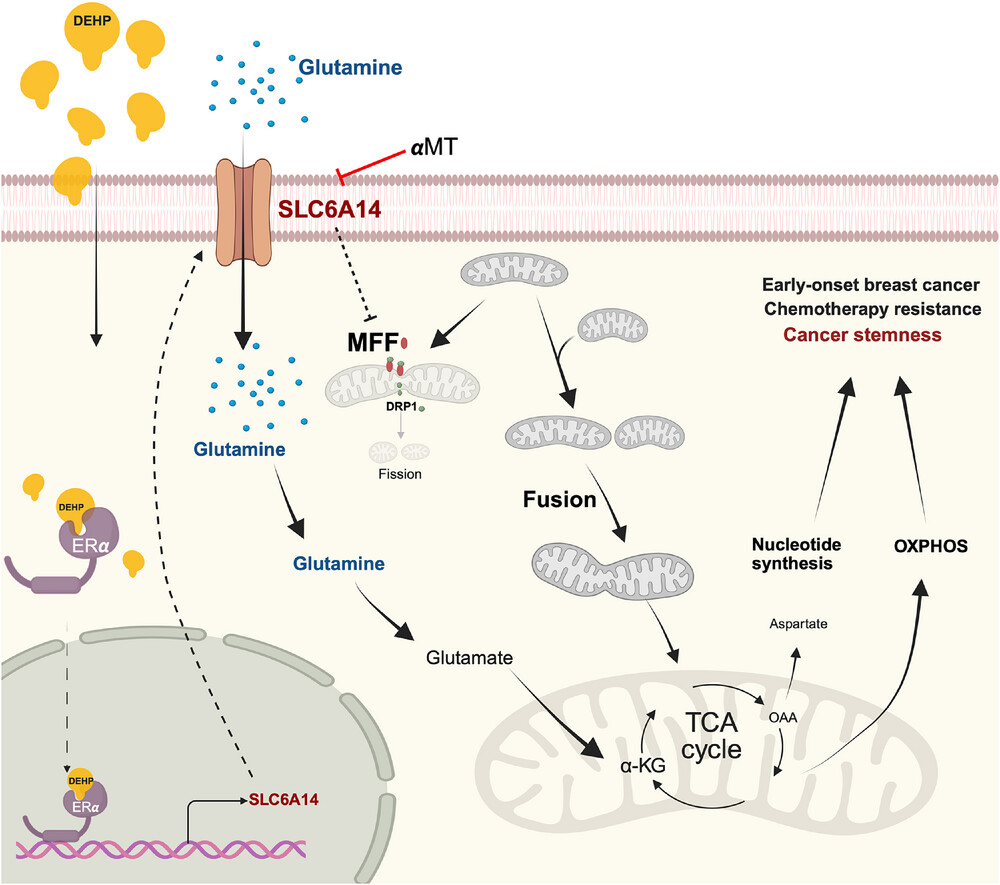
The answer appeared to lie in metabolism. The researchers found that DEHP exposure increased the expression of the SLC6A14 transporter protein. This protein functions as a gateway that allows cancer cells to import glutamine, a nutrient that rapidly dividing cells use as an energy source. With greater glutamine uptake, cancer cells shifted toward a metabolic state characterized by enhanced oxidative phosphorylation, a process occurring within mitochondria, the cell’s energy-producing structures.
What makes this finding particularly interesting is that the mitochondria did not simply become more active; they became more interconnected. The researchers observed increased mitochondrial fusion, forming extensive energy networks inside tumor cells. This structural and metabolic change strengthened what scientists call “cancer stemness,” a set of traits that allows certain tumor cells to initiate growth, resist treatment, and potentially drive recurrence.
When SLC6A14 was inhibited in laboratory models, glutamine uptake declined, mitochondrial fusion decreased, and the stem-like properties of cancer cells were reduced. Tumor growth slowed accordingly. These results suggest that SLC6A14 is not merely a metabolic bystander but a driver of aggressive tumor behavior, especially in early-onset cases.
The uniqueness of this research lies in connecting three layers of influence: environmental exposure, metabolic reprogramming, and cancer stem cell biology. Rather than viewing cancer purely as a genetic disease, this study illustrates how external chemical exposure may subtly reshape cellular energy systems, creating conditions that favor tumor progression.
While additional research is needed to confirm how these mechanisms operate over time in human populations, the findings open important avenues for both prevention and therapy. If SLC6A14 proves to be a reliable metabolic vulnerability, it could become a target for new treatment strategies, particularly for younger patients facing aggressive disease.
More broadly, this work highlights the importance of understanding how modern environmental exposures intersect with cellular biology. As societies grapple with rising cancer incidence among younger adults, insights into metabolic and environmental contributors may help guide safer product regulations, earlier screening strategies, and more precise therapeutic interventions in the near future.
Reference
D.-W. Hu et al., “SLC6A14 Drives Mitochondrial Fusion and Oxidative Phosphorylation to Promote Cancer Stemness and Early-Onset of Breast Cancer,“ Advanced Science, 2025, doi:10.1002/advs.202510811.

Huang, Wei-Chien(黃偉謙)
Center for Molecular Medicine, China Medical University Hospital, Taiwan

Publication Title: SLC6A14 Drives Mitochondrial Fusion and Oxidative Phosphorylation to Promote Cancer Stemness and Early-Onset of Breast Cancer
Journal Title: Advanced Science
Publisher: Wiley-VCH
Year: 2025
Subject: Medicine
Research Footprints:
Early-onset breast cancers (EOBCs); di(2-ethylhexyl)phthalate (DEHP);