Summary
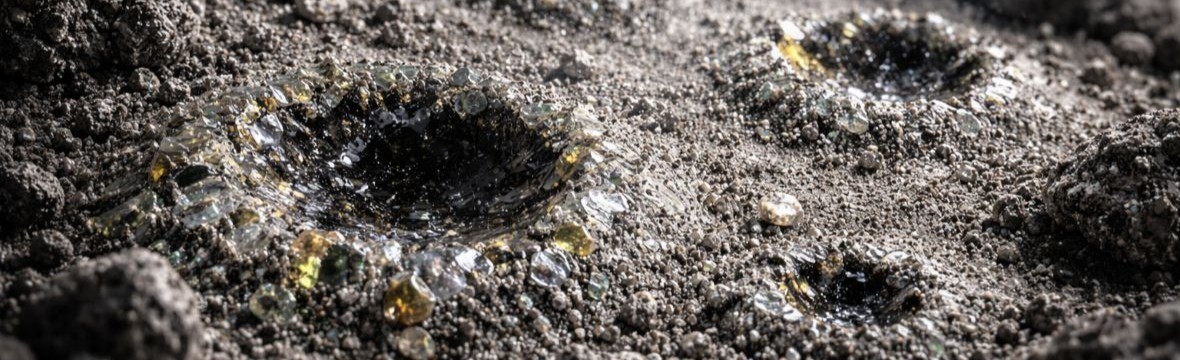
The Moon’s surface is constantly hit by tiny particles of cosmic dust called micrometeorites. Although these particles are very small, often only a few micrometers wide, they travel at extremely high speeds. When they impact the lunar surface, their energy can melt and vaporize nearby minerals.
In this study, scientists examined a small impact crater on a glass bead collected from the Moon by China’s Chang’e-5 mission. Using high-resolution transmission electron microscopy, the researchers found small deposits of titanium-oxide minerals around the rim of the crater. These deposits include two forms of Ti₂O that had never been identified before as natural minerals in lunar samples.
The findings suggest that these unusual minerals formed during the impact itself. When a micrometeorite hits the lunar surface, titanium-bearing minerals like ilmenite can briefly vaporize. As the hot vapor cools, titanium and oxygen atoms recombine and condense into tiny crystals that settle around the crater rim. Simultaneously, nanophase iron particles form nearby as part of the same process.
This discovery offers new insights into space weathering, the set of processes that gradually change the surfaces of airless planetary bodies like the Moon, Mercury, and asteroids. For decades, scientists believed that micrometeorite impacts could produce redeposited materials on lunar soil, but direct evidence was limited.
Interestingly, the newly found titanium oxides may also affect how lunar soil interacts with sunlight. Some titanium oxides can act as photocatalysts, meaning they can initiate chemical reactions when exposed to light. This indicates that micrometeorite impacts could subtly alter not only the physical properties of lunar soil but also its chemical reactivity. Since micrometeorite impacts happen across many airless worlds, similar processes may also take place on asteroids and other planetary bodies throughout the Solar System.
Reference
Zeng, Y. Wu, W. Yu, B. Mo, Y. Wen, X. Zhao, X. Li, X. Zhang, and J. Liu, “Unusual Ti minerals on the Moon produced by space weathering,” Nature Astronomy, vol. 8, pp. 732–738, 2024,doi: 10.1038/s41550-024-02229-4