Summary
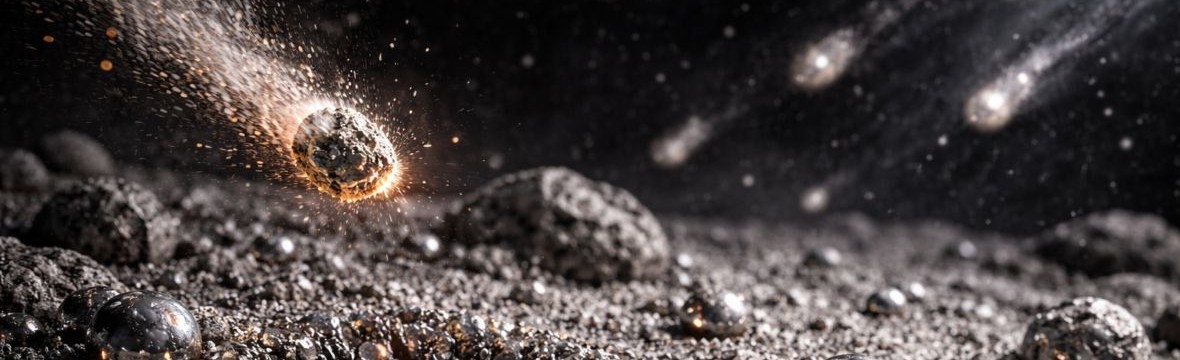
The Moon’s surface is constantly exposed to the harsh environment of space. Without an atmosphere for protection, lunar soil is continuously hit by tiny dust particles traveling through the Solar System. Over time, these impacts change the physical and chemical properties of the Moon’s surface through a process called space weathering.
One key feature of space-weathered lunar soil is the presence of extremely small iron particles known as nanophase iron. These nanoparticles, often only a few billionths of a meter in size, significantly affect how lunar soil reflects and absorbs sunlight. Because of this, they are critical for how scientists interpret data collected by spacecraft observing the Moon and other airless bodies.
In this study, researchers analyzed lunar samples returned by China’s Chang’e-5 mission using advanced electron microscopy techniques. They identified unusual iron nanoparticles embedded within glassy materials formed during micrometeorite impacts. Detailed analysis showed that some of these particles have chemical compositions different in presence area from previously known nanophase iron.
The researchers concluded that these unique nanoparticles likely originate from cosmic dust particles themselves, rather than forming solely from lunar minerals during impact events. When micrometeorites hit the Moon at extremely high speeds, the impacting dust can melt, vaporize, and mix with lunar materials. As the material cools quickly, iron nanoparticles form within the resulting glass.
This discovery suggests that micrometeorites do more than just disturb the lunar surface, they can also directly contribute new materials that affect the Moon’s optical and chemical properties. Understanding how these nanoparticles form is vital for interpreting remote sensing observations of the Moon and other airless bodies like asteroids and Mercury. The findings also highlight how even the tiniest particles traveling through space can leave lasting marks on planetary surfaces.
Reference
X. Zeng et al., “Exotic nanophase iron as a new agent for space weathering on the Moon,” The Astrophysical Journal Letters, vol. 983, 2025, doi: 10.3847/2041-8213/adbf88