Summary
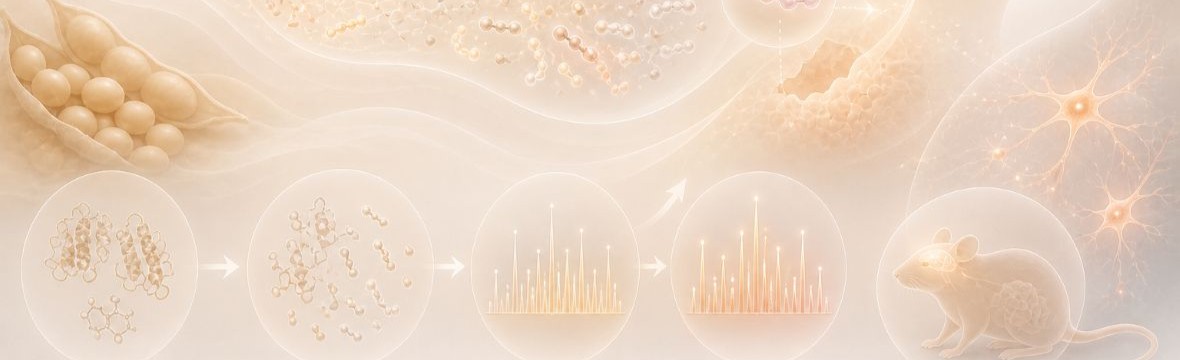
This research investigates how fermentation transforms soybeans into a source of naturally occurring bioactive peptides, with a particular focus on peptides that may support neurological health. While soybeans are widely consumed for their protein content, the specific peptides generated during traditional fermentation—and their biological relevance—have remained largely unexplored.
Using an advanced liquid chromatography–mass spectrometry (LC–MS) peptidomics approach, the researchers systematically profiled peptides present in fermented soybeans. They identified 714 native peptides, including 561 newly discovered sequences, with about 75% either unique to fermented samples or significantly increased by fermentation. Many of these peptides originated from major soybean proteins, including proteins associated with allergenicity, indicating that fermentation reshapes both the composition and functionality of soybean proteins.
A key novelty of this study is its emphasis on native peptides formed naturally during fermentation, rather than peptides generated by laboratory-based enzymatic hydrolysis. This provides a more realistic representation of what is actually consumed in fermented foods. Computational analysis showed that several peptides have strong binding affinity to monoamine oxidases (MAO-A and MAO-B), enzymes involved in neurotransmitter regulation. Selected peptides further demonstrated neuroprotective effects in neuronal cell models, supporting their potential functional role.
The potential impact of this work lies in its contribution to functional food development. By revealing how fermentation releases previously hidden bioactive peptides with neurological relevance, the study offers a scientific basis for designing fermented soybean products aimed at supporting mental health and brain function.
Reference
L. Zhang, S. Gong, Y. Zuo, L. Zhang, J. Chen, Y. Xu, Y. Wu, Y. Zhao, J.-L. Wu, and N. Li, “Soybean fermentation drives the production of native neuroprotective peptides based on a peptidomics strategy,” Current Research in Food Science, vol. 10, article 101082, 2025, doi: 10.1016/j.crfs.2025.101082.