

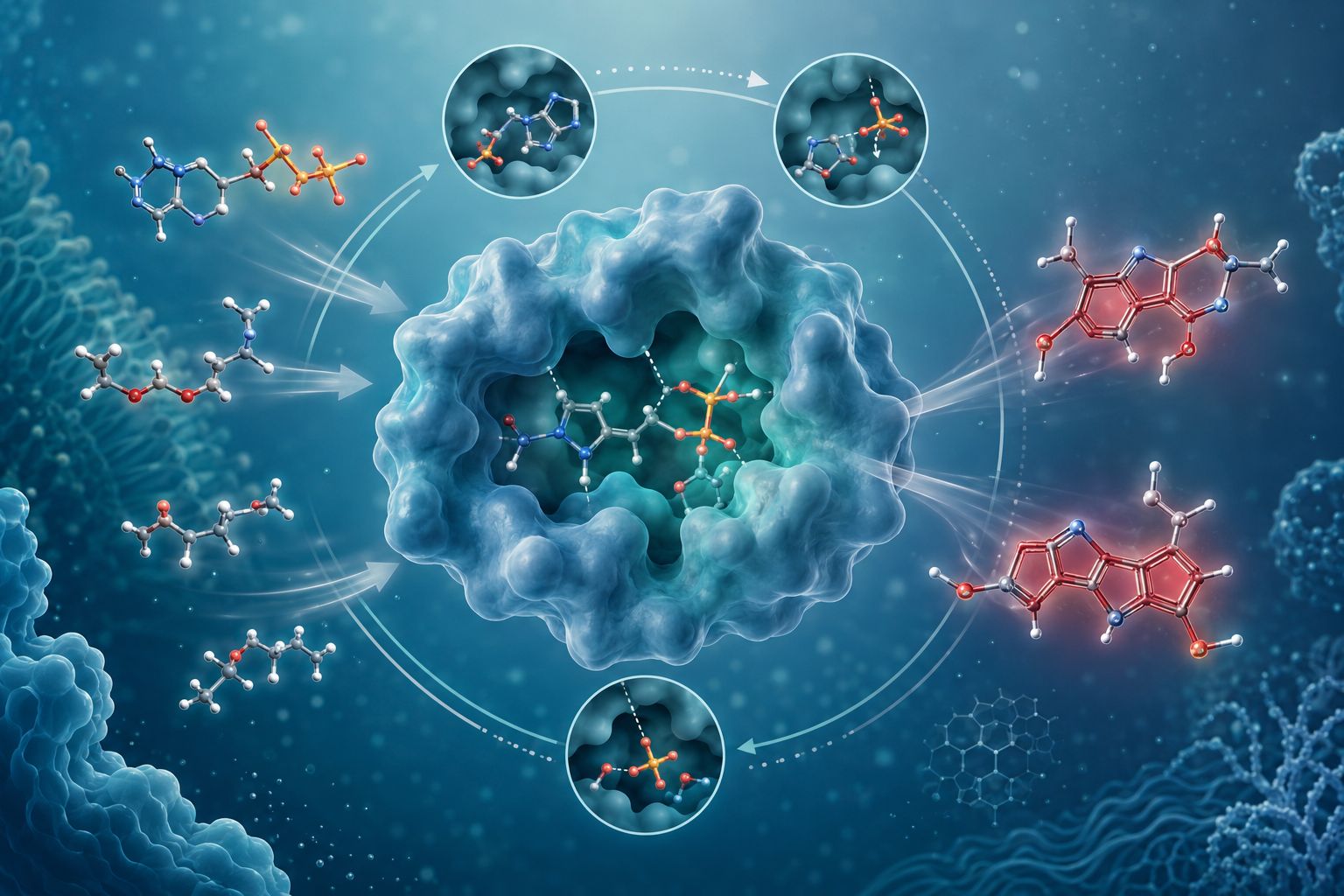
Understanding a marine bacterial enzyme that can build new prodiginine compounds
This study investigates HapC, an enzyme that performs the final step in producing prodigiosin-related compounds called prodiginines. These red-pigmented bacterial molecules are of scientific interest because they have shown antibacterial, anticancer, immunosuppressive, antifungal, and plant-protection activities.
Researchers from Taipei Medical University showed that HapC can accept modified short-chain building blocks and produce six non-native prodiginine compounds in the laboratory. Two of them—3,4-dimethyl-6-methoxyprodiginine and 2-ethyl-6-methoxyprodiginine—had not previously been successfully produced by any prodigiosin-forming enzyme.
The team also proposed how HapC works. Using structural modeling and docking simulations, they described a three-phase catalytic cycle involving ATP binding, substrate positioning, phosphate transfer, product formation, and product release. This gives researchers a clearer basis for using HapC to generate new prodiginine analogs for future testing.
The Background
Many medicines and agricultural compounds have origins in natural products made by microorganisms. Prodigiosin is one example. Beyond its red color, it has attracted attention because prodiginine compounds can interact with biological targets such as DNA, proteins, and metal ions.
However, natural compounds often need to be modified before they can become useful research leads. Small changes in chemical side chains can affect how a molecule binds, dissolves, remains stable, or behaves in biological systems. For prodiginines, such modifications may help researchers explore which structures are most promising.
A key challenge is how to create diverse prodiginine analogs efficiently. Chemical synthesis can be complex, while enzyme-based production may offer a more selective route. Before this study, HapC was less understood than related enzymes. By combining laboratory synthesis, chemical analysis, structural modeling, and docking simulations, the team clarified both what HapC can make and how it may work.
The SDG impact
This research supports long-term progress in health-related innovation and aligns most closely with UN Sustainable Development Goal 3: Good Health and Well-being. Prodiginine compounds are being studied for possible biomedical uses, including antibacterial and anticancer research.
The study does not claim that the newly synthesized compounds are ready to become medicines. Its value lies earlier in the discovery pathway: it provides a clearer way to generate and study chemical diversity within a biologically active compound family.
The findings may also be relevant to agriculture and biotechnology, as prodigiosin-related compounds have been studied for biocontrol activity. By explaining HapC’s mechanism and showing its ability to produce previously inaccessible analogs, the study supports the use of microbial enzymes as precision tools for future health, agriculture, and natural-product research.
Reference
Chan, Y.-T., Rizkita, A.D., Hsieh, H.-J., Hsu, S.-F., Lin, T.E., Huang, W.-J., Hsu, K.-C., Nathan, S., Chang, P., Wang, A.H.-.-J. and Lee, C.-C. (2026), Mechanistic insights into HapC: A key enzyme in prodiginine biosynthesis in Hahella chejuensis. FEBS J. https://doi.org/10.1111/febs.70518

Andrew H.-J. Wang (王惠鈞)
University Chair Professor, College of Medical Science and Technology
Member, TMU Research Center of Cell Therapy and Regeneration Medicine


Cheng-Chung Lee (李政忠)
Taipei Medical University: Taipei, TW – Associate Research Fellow, The Ph.D. Program for Translational Medicine, College of Medical Science and Technology
Publication Title: Mechanistic insights into HapC: A key enzyme in prodiginine biosynthesis in Hahella chejuensis
Journal Title: The FEBS Journal
Publisher: John Wiley & Sons
Year: 2026
Subject: Biochemistry
Research Footprints:
Prodiginine; Prodigiosin; Marine bacteria; Enzyme mechanism; Natural products; Drug discovery; Biocontrol agents; Biosynthesis