

Open Access Is Growing in Southeast Asia, but Visibility Still Needs Work
Open access has become an important part of research systems across Southeast Asia. Many countries and institutions have made strong progress in making research outputs more available to the public, policymakers, industry partners, and the wider academic community.
But availability does not always translate into visibility.
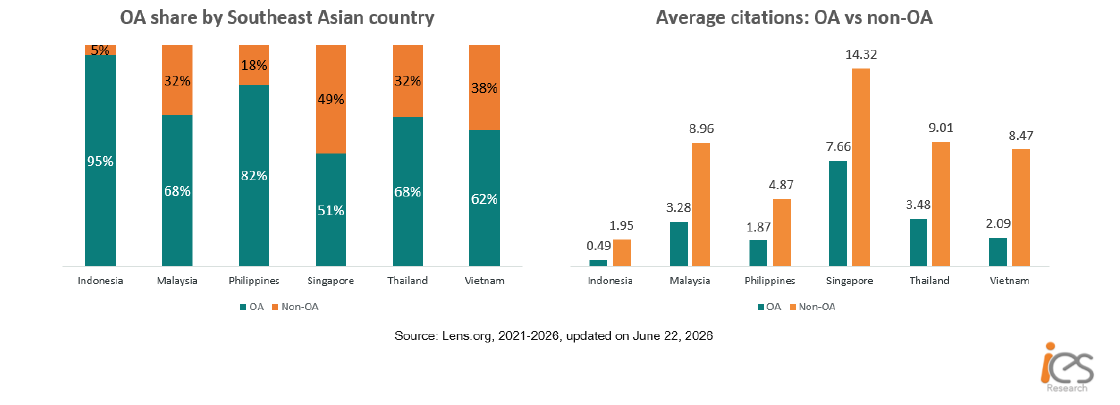
Based on iesResearch’s analysis of Lens.org data from 2021 to 2026, open access adoption is already high across several Southeast Asian research systems. Indonesia leads the group, with 95% of publications available as open access, followed by the Philippines at 82%. Malaysia and Thailand both stand at 68%, while Vietnam reaches 62% and Singapore reaches 51%.
These figures point to real progress. They suggest that open access has become a meaningful part of the regional research landscape.
The citation data, however, shows a more complex picture. Across the Southeast Asian countries included in the analysis, non-open access publications still receive higher average citation counts than open access publications. This does not mean that open access is ineffective. Citation performance can reflect many factors, including field, journal selection, publication age, indexing, collaboration networks, and international readership. Still, the pattern highlights an important point: making research available is only one part of making research visible.
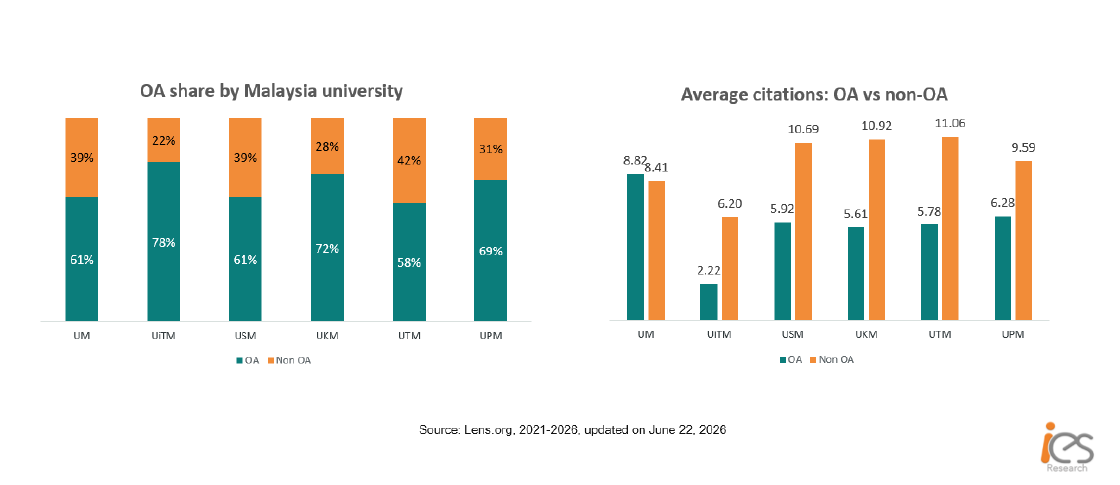
Malaysia shows a similar challenge at the university level. Leading Malaysian universities in the analysis have high open access adoption, ranging from 58% to 78%. Even so, most still see stronger citation performance from non-open access publications. Universiti Malaya is the exception, with open access publications receiving slightly higher average citation counts than non-open access publications.
The lesson is clear: open access expands availability, but it does not automatically guarantee reach.
For universities and research institutions, this creates an important strategic question. Once research becomes open, how can institutions help it travel further?
One answer lies in building stronger research visibility systems. These systems may include better metadata quality, stronger repository practices, clearer international positioning, media outreach, researcher profiling, multilingual communication, and audience-specific content. A paper may be open, but if it is difficult to find, difficult to understand, or disconnected from relevant communities, its potential impact remains limited.
This matters especially for Southeast Asia. The region produces research with high relevance to global challenges, from public health and climate adaptation to agriculture, biodiversity, technology, education, and urban development. Stronger research visibility can help these contributions reach international collaborators, policymakers, industry partners, and communities beyond the academic publishing system.
Open access answers the question of availability. Research visibility answers the question of whether the right people can find, understand, and use the work.
As open access continues to grow, the next opportunity for institutions is not only to publish more openly, but to communicate more strategically. The future of research impact will depend on both access and visibility.

About iesResearch
We share your discovery.
iesResearch helps universities and research institutions make research easier to find, understand, and use through research communication, visibility strategy, and outreach.