
Open Access Is Growing in Southeast Asia, but Visibility Still Needs Work

Open Access Is Growing in Southeast Asia, but Visibility Still Needs Work   Open access has become an important part of research systems across Southeast Asia. Many countries and institutions have made strong progress in making research outputs more available to the public, policymakers, industry partners, and the wider academic community. But availability does not…


Teaching AI to handle the messy real world

Teaching AI to handle the messy real world MUST researchers are developing solutions across 13 patented technologies to enable AI to handle incomplete, mismatched, and unfamiliar data, ranging from medical images and factory sensors to underground geology and planetary surfaces. Artificial intelligence excels at recognizing patterns when it is provided with the right kind of…

Making medicines survive the journey: how MUST researchers are tackling the biological barriers between a promising treatment and its effect

Making medicines survive the journey: how MUST researchers are tackling the biological barriers between a promising treatment and its effect   A promising treatment must do more than fight disease. Across 12 inventions, researchers are drawing on chemistry, RNA biology, immunology, pharmacology and materials science to tackle the barriers a medicine can encounter before it…

From Bright but Fragile to Ceramic-Stable and Printable: Professor Liang Li’s Quantum-Dot Innovation Journey

Post Views: 793 From Bright but Fragile to Ceramic-Stable and Printable: Professor Liang Li’s Quantum-Dot Innovation Journey Overview: The Real Problem Is Survival Quantum dots and perovskite nanocrystals have long been regarded as ideal light-emitting materials. They offer high color purity, strong absorption, narrow emission, and solution processability—qualities that make them attractive for displays, lighting,…

Understanding a marine bacterial enzyme that can build new prodiginine compounds

Post Views: 247 Understanding a marine bacterial enzyme that can build new prodiginine compounds The Novelty   This study investigates HapC, an enzyme that performs the final step in producing prodigiosin-related compounds called prodiginines. These red-pigmented bacterial molecules are of scientific interest because they have shown antibacterial, anticancer, immunosuppressive, antifungal, and plant-protection activities.  Researchers from Taipei Medical University showed…

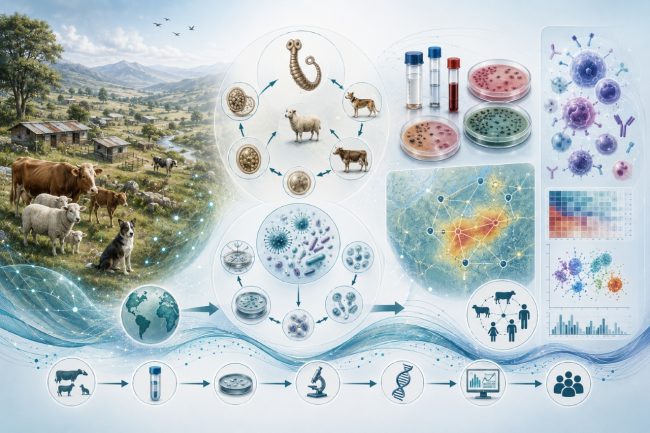
Tracking Diseases That Move Between Animals and Humans: An Integrated Zoonotic Surveillance Model from Kazakhstan

Post Views: 605 Tracking Diseases That Move Between Animals and Humans: An Integrated Zoonotic Surveillance Model from Kazakhstan In regions where livestock farming, rural livelihoods, and human settlements closely intersect, zoonotic diseases are not isolated events—they are part of a dynamic transmission ecosystem. A coordinated body of research from Asfendiyarov Kazakh National Medical University (KazNMU)…

Mental Health Across the Life Course: Integrative Neurodevelopmental Research from KazNMU

Post Views: 805 Mental Health Across the Life Course: Integrative Neurodevelopmental Research from KazNMU Mental health vulnerabilities unfold across developmental stages and are shaped by biological, behavioral, and structural determinants. A coordinated body of scholarship from Asfendiyarov Kazakh National Medical University (KazNMU) advances a life-course framework that integrates maternal psychiatry, neurodevelopment, caregiver psychology, digital behavioral…

Mapping the Medicinal Flora of Kazakhstan: Phytochemical Fingerprinting and Bioactivity of Native Plants from KazNMU

Post Views: 746 Mapping the Medicinal Flora of Kazakhstan: Phytochemical Fingerprinting and Bioactivity of Native Plants from KazNMU Kazakhstan’s steppe and mountain ecosystems host medicinal plants widely used locally but still underrepresented in the international evidence base. In this thematic cluster, researchers connected to Asfendiyarov Kazakh National Medical University (KazNMU) take a deliberately cross-disciplinary approach—pairing phytochemical fingerprinting (what is inside the…