
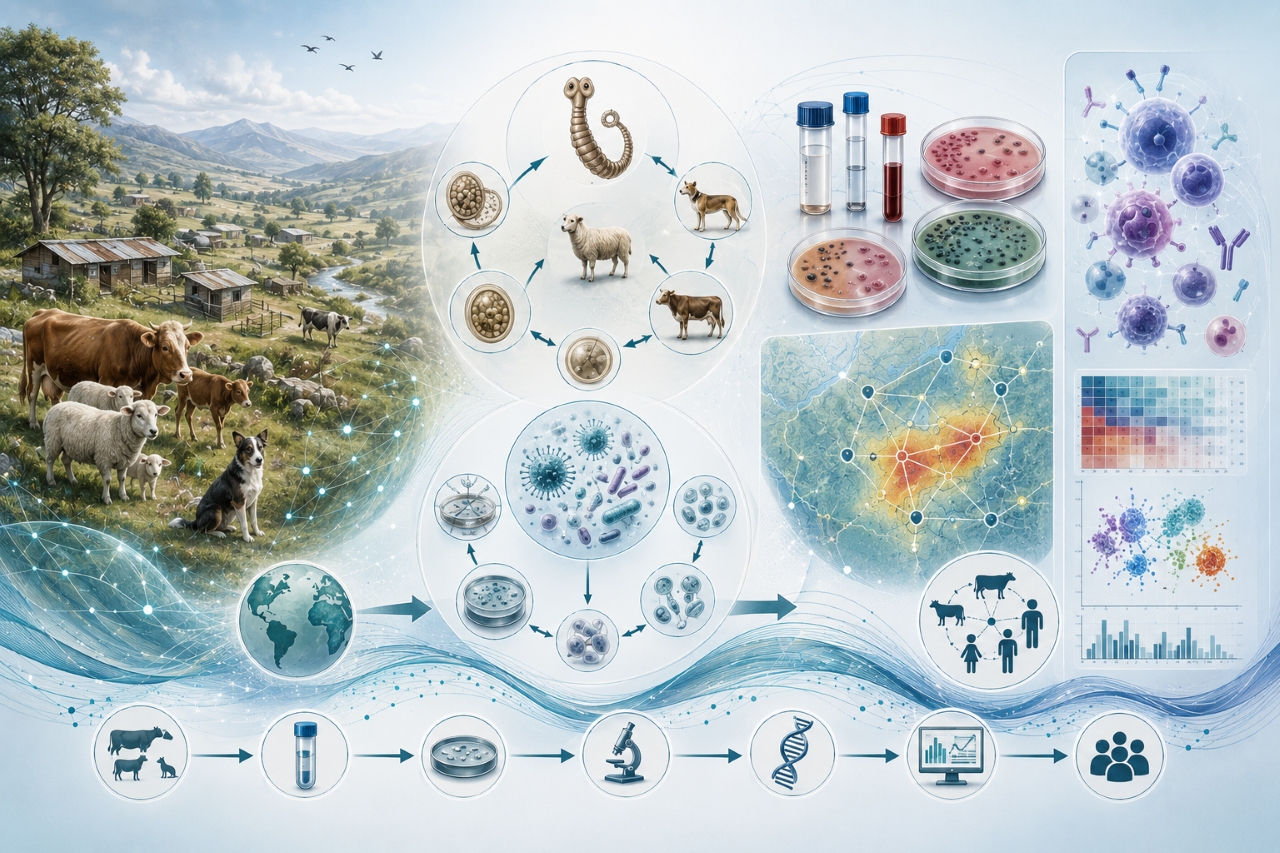
Tracking Diseases That Move Between Animals and Humans: An Integrated Zoonotic Surveillance Model from Kazakhstan
Rather than focusing on single pathogens, this research cluster forms a connected surveillance narrative—linking endemic parasitic disease, acute outbreak investigation, vector-borne exposure mapping, molecular pathogen tracing, and post-infectious immune consequences into a unified One Health framework.
Cystic echinococcosis (CE), a parasitic infection transmitted through livestock–dog–human cycles, remains endemic in Kazakhstan. A pediatric investigation revealed a high proportion of children presenting with active-stage disease, indicating ongoing transmission in affected regions [1]. Building on this epidemiological foundation, a large-scale clinical study of 485 patients compared open surgery, laparoscopy, and the minimally invasive PAIR procedure. The findings demonstrated significantly shorter operation times and hospital stays for PAIR without increased relapse risk, supporting stage-specific treatment optimization aligned with WHO classifications [2]. Together, these studies connect surveillance data with evidence-based therapeutic strategies.
The same field epidemiology infrastructure has strengthened rapid outbreak response. During a 2022 wedding-associated gastroenteritis outbreak, investigators conducted a retrospective cohort analysis, an environmental assessment, and laboratory confirmation to identify honey cake prepared with raw eggs as the source of Salmonella Enteritidis infection [3]. This work illustrates how analytic epidemiology and microbiological confirmation converge to contain foodborne transmission.
Beyond foodborne pathogens, vector-borne and rodent-associated threats have also been systematically investigated. An outbreak of Crimean-Congo hemorrhagic fever (CCHF) in the Kyzylorda region required coordinated case investigation, exposure tracing, and laboratory diagnostics [4]. Meanwhile, a cross-sectional seroprevalence study in West Kazakhstan detected hantavirus IgG antibodies in 3.1% of high-risk adults, revealing occupational and environmental risk factors even in the absence of clinically recognized disease [5]. These findings underscore the importance of proactive exposure mapping in endemic regions.
At the livestock–human boundary, molecular epidemiology has further strengthened surveillance precision. An analysis of anthrax cases in Zhambyl region combined clinical investigation with MLVA genotyping, identifying multiple genetic clusters of Bacillus anthracis, including strains linked to regional circulation and localized evolution [6]. The detection of new foci highlights the need for continuous monitoring in livestock trade zones.
Finally, the cluster extends into post-infectious immune consequences. A study of children with multisystem inflammatory syndrome associated with SARS-CoV-2 (MIS-C) documented significant immune dysregulation in severe cases, including altered T-cell subsets and elevated inflammatory markers [7]. This work demonstrates that surveillance does not end at infection detection—it also informs preparedness for immunological complications following epidemics.
Collectively, these investigations reveal a distinctive strength of KazNMU’s approach: integrating field epidemiology, laboratory confirmation, molecular tracing, clinical staging, and immune profiling within a single national surveillance ecosystem. In a region where human and animal health are deeply interconnected, this systems-based model offers a scalable framework for strengthening zoonotic disease preparedness across Central Asia.
References
- Doszhanova G, Colpani A, Duisenova A, et al. The high burden of pediatric cystic echinococcosis in Kazakhstan: epidemiological and clinical consequences. Trans R Soc Trop Med Hyg. 2023;117(12):875–877, doi:1093/trstmh/trad065
- Nagasbekov M, Baimakhanov Z, Doskhanov M, et al. Cystic echinococcosis of the liver in Kazakhstan: The effectiveness of the PAIR method in comparison with laparoscopic and open surgical methods. Asian J Surg. 2024;47(11):4711–4716, doi:1016/j.asjsur.2024.05.170
- Gazezova S, Nabirova D, Waltenburg M, et al. Salmonellosis outbreak associated with the consumption of food at a wedding in an urban restaurant in Kazakhstan: a retrospective cohort study. BMC Infect Dis. 2024;24:1464, doi:1186/s12879-024-10382-4
- Gazezova S, et al. Outbreak of Crimean-Congo hemorrhagic fever in Kyzylorda region, Kazakhstan, March–July 2022. Front Public Health. 2025;13:1519261, doi:3389/fpubh.2025.1519261
- Gubareva U, Horth R, Nabirova D, et al. Hantavirus antibody seroprevalence and risk factors among adults in West Kazakhstan, 2023. Front Public Health. 2025;12:1519117, doi:3389/fpubh.2024.1519117
- Izbanova U, Rysbekova A, Zhumadilova Z, et al. Epidemiological and molecular analysis of anthrax cases of the Zhambyl region Kazakhstan, in 2023. Front Public Health. 2025;13:1620930, doi:3389/fpubh.2025.1620930
- Jaxybayeva I, Boranbayeva R, Bulegenova M, Urazalieva N. Clinical and immunological features in children with multisystem inflammatory syndrome associated with SARS-CoV-2. Acta Biomed. 2023;94(2):e2023016, doi:23750/abm.v94i2.13777

From Natural Products to Drug Candidates: A Two-Way Research Model for Future Therapies in Cardiovascular, Arthritis, and Cancer Diseases
Over the past two decades, under the leadership of Professor Yi-Zhun Zhu, researchers at the Macau University of Science and Technology have been focusing on a distinctive bidirectional research model for small molecule drug development. This integrated strategy combines two complementary approaches: “from bioactive natural compounds to novel target identification” and “from novel therapeutic target to new small-molecule development.” Moving beyond conventional linear drug discovery processes, this framework facilitates bidirectional innovation, advancing both fundamental researches and translational applications.
Drug discovery can be conceptualized as an exploration on a vast island. Traditional approaches often follow a single linear route toward therapeutic breakthroughs, namely, the treasure. In contrast, the bidirectional model offers greater flexibility. Investigations may begin with a “coin” already in hand—such as Leonurine (SCM-198), S-Propargyl-Cysteine (SPRC), the natural compounds functioning as a valuable starting point. By studying that coin closely, researchers uncover clues about its origins, which in turn point them toward new biological targets and therapeutic directions, including NOX4, SMYD3, JMJD3, HDAC6 and so on. Alternatively, the journey begins the other way around, with a “map” in hand—a promising biological mechanism such as HDAC6/MyD88/NF-κB signaling pathway or STAT3-NAV2 axis in arthritis, serving as a guide for rational drug design. In both cases, the two pathways converge, leading to synergistic advances in drug discovery.
This strategy has yielded significant milestones, including the industrial translation of first-in-class therapeutics, and continues to drive progress across multiple therapeutic areas. In particular, the model has guided three major research trajectories: starting with leonurine, a natural product with traditional cardiovascular applications that has been advanced into modern drug development; extending into SPRC, a synthetically designed modulator of hydrogen sulfide; and progressing to epigenetic drug discovery through SMYD3 inhibition, a path with implications for vascular aging and oncology. Collectively, these directions illustrate how atural product-derived insights and target-driven design can converge within a single framework to shape the next era of medicine.
From Small molecule-to-Target: Leonurine
The journey along the “small molecule-to-target” pathway began with leonurine, a compound derived from Leonurus japonicus, a plant used in traditional medicine for cardiovascular health and gynecological diseases. What makes Leonurine significant is not only its herbal origins but also its development into a scientifically validated compound with cardioprotective effects, anti-inflammatory properties, pro-angiogenic effects following cardiac injury, and potential applications beyond cardiovascular disease which accounts for 17.9 million annual deaths globally [1] [2,3]. Beyond cardiovascular applications, it has demonstrated efficacy in mitigating endometriosis via modulation of estrogen-mediated immune dysfunction [4], as well as anti-atherosclerotic and hepatoprotective activities [5,6]. The team has also advanced Leonurine into novel formulations, the team developed a sustained-release leonurine formulation using PLGA microspheres encapsulating drug nanocrystals (Leo-nano@MP), which significantly improved lipid metabolism and reduced dosing frequency via subcutaneous administration in a hyperlipidemic rat model, demonstrating high drug loading, prolonged release, and good biocompatibility [7].
This pathway exemplifies how a single bioactive natural product can unravel novel mechanisms and open new therapeutic avenues. Leonurine thus serves as a prototype for transforming traditional herbal compounds into first-in-class therapeutics with validated mechanisms of action.
The translational development of Leonurine is supported by multiple patents from Professor Zhu’s group, covering pharmaceutical formulations and delivery technologies. For example, these include nanoliposome and microsphere systems that enhance bioavailability and enable controlled release, broadening the therapeutic window for cardiovascular and inflammatory diseases. Their patents also highlight leonurine’s role in modulating lipid metabolism, PPARγ pathways, and its use in treating liver disease and inflammation-related disorders. Collectively, these innovations elevate Leonurine from a traditional herbal compound into a modern, patent-protected therapeutic entity with substantial clinical potential.
From Small molecule-to-Target: another example, SPRC and CSE
If Leonurine represents the journey from monomer to target, S-Propargyl-Cysteine (SPRC) illustrates the complementary path—from target to molecule. Here, the therapeutic target is cystathionine Gamma Lyase (CSE), an enzyme that produces the signaling molecule hydrogen sulfide (H₂S) from L-cysteine. SPRC acts as a donor of endogenous H₂S, an endogenous gasotransmitter known for its profound effects on vascular health, inflammation, and longevity. Based on this mechanistic insight, SPRC was designed as a synthetic amino acid derivative that modulates H₂S levels.
Based on Professor Zhu’s studies, SPRC has demonstrated wide-ranging benefits: regulating immune responses, protecting neurons after stroke, and promoting angiogenesis [8,9]. In rheumatoid arthritis (RA), which affects over 18 million people globally [10], SPRC has been shown to rebalance immune cells by inhibiting the JAK/STAT pathway, reducing inflammation and slowing joint damage [11]. Beyond exploring the pharmacological efficacy of SPRC, the team have also engineered SPRC-based nanocarriers and hybrid molecules for precision therapies against RA,
This small molecule-to-target pathway highlights how identifying a novel biological mechanism—in this case, CSE as the target of SPRC—can inspire the rational design of first-in-class therapeutic candidates with translational potential.
Patents filed by Professor Zhu and his team surrounding SPRC and related signaling pathways demonstrate the translational depth of this pathway by engineering innovative drug delivery platforms. Microsphere and mesoporous silica formulations enhance the stability and sustained release of SPRC, improving its therapeutic precision in diseases such as rheumatoid arthritis and ischemic injury. Additionally, their patents on endogenous H₂S donors for RA treatment underscore the progression from mechanistic insight to tangible therapeutic inventions. These intellectual property advances ensure SPRC’s positioning not just as a promising molecule, but as a scalable and clinically adaptable treatment strategy.
Target-to-Molecule: SMYD3 and Epigenetic Regulation
Extending the target-driven approach further, the researchers turned their attention to the epigenetic regulator SMYD3, a histone methyltransferase linked to vascular aging, cellular remodeling, and cancer progression. Unlike Leonurine’s herbal origins, SMYD3 inhibition begins firmly at the target level, with the goal of designing molecules that disrupt pathogenic gene regulation.
Professor Zhu’s research team showed that, through high-throughput screening and structure-based drug design, small molecules such as ZYZ384 were identified to reduce cancer cell proliferation by lowering H3K4 trimethylation on oncogenic promoters. In models of hepatocellular carcinoma, SMYD3 inhibition suppressed tumor growth, offering a new precision epigenetic strategy against cancer [14]. Beyond oncology, targeting SMYD3 also addresses vascular senescence, the progressive aging of blood vessels that underlies hypertension, atherosclerosis, and stroke [15,16].
This work demonstrates how the target-to-molecule pathway can move beyond classical signaling molecules into the realm of epigenetics, opening entirely new frontiers for precision therapies in both cancer and age-related vascular disease.
The translational impact of SMYD3 research is evidenced by patents from Professor Zhu’s team covering novel SMYD3 inhibitors and their use in treating cancer and vascular disorders. These patents protect chemical entities capable of selectively modulating histone methylation, establishing a foundation for first-in-class epigenetic therapeutics in oncology and cardiovascular medicine.
The Bidirectional Model: Advancing Integrated Drug Discovery
Together, these approaches illustrate a cycle of discovery that moves beyond the conventional linear model of drug development. By leveraging natural products for target deconvolution and employing target-based rational design for new chemical entities, this bidirectional framework bridges traditional knowledge and contemporary science, integrating basic research with clinical translation. This model provides a robust and efficient strategy for developing small-molecule therapies that address major unmet medical needs in cardiovascular disease, arthritis, and cancer.
*Notes: This article provides research teasers for each reference to showcase the novelties
List of Patents
Preparation Method and Application of Leonurine Sustained-Release Microspheres
Preparation Method and Application of a Small-Molecule Inhibitor of Histone Methyltransferase SMYD3
Preparation Method of SCM198 Gel for Treating Skin Injuries
Microsphere Formulation Loaded with S-Propargyl-Cysteine and Its Preparation Method
Mesoporous Silica Formulation Loaded with S-Propargyl-Cysteine and Its Preparation Method
Endogenous Hydrogen Sulfide Sustained-Release Formulation: Preparation Method and Application
References
[1] https://www.who.int/health-topics/cardiovascular-diseases
[2] S. Luo, S. Xu, J. Liu, F. Ma, and Y. Z. Zhu, “Design and synthesis of novel SCM-198 analogs as cardioprotective agents: Structure-activity relationship studies and biological evaluations,” European Journal of Medicinal Chemistry, vol. 200, p. 112469, Aug. 2020, doi: 10.1016/j.ejmech.2020.112469.
[3] Z. Song, K. Song, Y. Xiao, H. Guo, Y. Zhu, and X. Wang, “Biologically Responsive Nanosystems Targeting Cardiovascular Diseases,” CDD, vol. 18, no. 7, pp. 892–913, Aug. 2021, doi: 10.2174/1567201818666210127093743.
[4] Y. Li et al., “Scm-198 alleviates endometriosis by suppressing estrogen-erα mediated differentiation and function of cd4+ cd25+ regulatory t cells,” Int. J. Biol. Sci., vol. 18, no. 5, pp. 1961–1973, 2022, doi: 10.7150/ijbs.68224.
[5] Y.-Y. Qiu, J. Zhang, F.-Y. Zeng, and Y. Z. Zhu, “Roles of the peroxisome proliferator-activated receptors (Ppars) in the pathogenesis of nonalcoholic fatty liver disease (Nafld),” Pharmacological Research, vol. 192, p. 106786, Jun. 2023, doi: 10.1016/j.phrs.2023.106786.
[6] M. Huang et al., “The multifaceted anti-atherosclerotic properties of herbal flavonoids: A comprehensive review,” Pharmacological Research, vol. 211, p. 107551, Jan. 2025, doi: 10.1016/j.phrs.2024.107551.
[7] Song Z, Meng S, Tang Z, Yang X, He Y, Zheng Y, Guo H, Du M, Zhu Y, Wang X. Injectable leonurine nanocrystal-loaded microspheres for long-term hyperlipidemia management. Biomater Sci. 2023 Jun 27;11(13):4713-4726. doi: 10.1039/d3bm00211j.
[8] S. Liu et al., “Endogenous hydrogen sulfide regulates histone demethylase JMJD3-mediated inflammatory response in LPS-stimulated macrophages and in a mouse model of LPS-induced septic shock,” Biochemical Pharmacology, vol. 149, pp. 153–162, Mar. 2018, doi: 10.1016/j.bcp.2017.10.010.
[9] Y. Xiong et al., “ZYZ-803, a novel hydrogen sulfide-nitric oxide conjugated donor, promotes angiogenesis via cross-talk between STAT3 and CaMKII,” Acta Pharmacol Sin, vol. 41, no. 2, pp. 218–228, Feb. 2020, doi: 10.1038/s41401-019-0255-3.
[10] https://www.who.int/news-room/fact-sheets/detail/rheumatoid-arthritis
[11] W. Cai et al., “S-propargyl-cysteine attenuates temporomandibular joint osteoarthritis by regulating macrophage polarization via Inhibition of JAK/STAT signaling,” Mol Med, vol. 31, no. 1, p. 128, Apr. 2025, doi: 10.1186/s10020-025-01186-6.
[12] Q. Ding et al., “Signaling pathways in rheumatoid arthritis: implications for targeted therapy,” Sig Transduct Target Ther, vol. 8, no. 1, p. 68, Feb. 2023, doi: 10.1038/s41392-023-01331-9.
[13] Z. Tang et al., “Neutrophil‐Mimetic, ROS Responsive, and Oxygen Generating Nanovesicles for Targeted Interventions of Refractory Rheumatoid Arthritis,” Small, vol. 20, no. 20, p. 2307379, May 2024, doi: 10.1002/smll.202307379.
[14] Q. Ding et al., “A novel small molecule ZYZ384 targeting SMYD3 for hepatocellular carcinoma via reducing H3K4 trimethylation of the Rac1 promoter,” MedComm, vol. 5, no. 10, p. e711, Oct. 2024, doi: 10.1002/mco2.711.
[15] Q. Ding, C. Shao, P. Rose, and Y. Z. Zhu, “Epigenetics and Vascular Senescence–Potential New Therapeutic Targets?,” Front. Pharmacol., vol. 11, p. 535395, Sep. 2020, doi: 10.3389/fphar.2020.535395.
[16] Z. Lin et al., “Discovery of deoxyandrographolide and its novel effect on vascular senescence by targeting HDAC1,” MedComm, vol. 4, no. 5, p. e338, Oct. 2023, doi: 10.1002/mco2.338.