
Blocking a Tumor’s Protective Signal Strengthens Immune Defense
In this study, researchers investigated the role of CD24, a cell surface protein known to contribute to tumor progression and immune evasion. CD24 has been implicated in suppressing macrophage-mediated phagocytosis and limiting T cell activation. To examine its functional role more directly, the team used CRISPR/Cas9 gene editing to knock out CD24a in TNBC cells and evaluated tumor development in murine models.
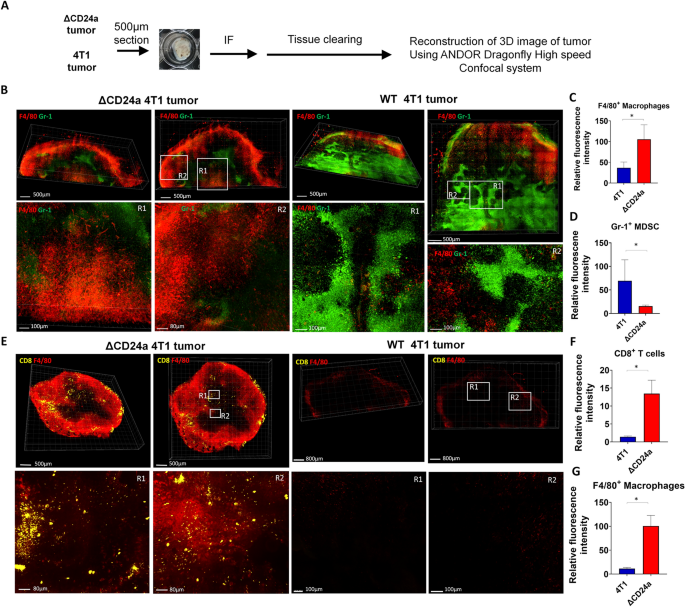
The results were striking. Tumors lacking CD24a grew significantly more slowly than control tumors. Detailed immune profiling revealed substantial changes within the tumor microenvironment. There was increased infiltration of M1 macrophages, which promote inflammatory and anti-tumor activity. At the same time, cytotoxic CD8⁺ T cells, key players in adaptive immune responses, were more abundant and functionally active.
Conversely, immunosuppressive cell populations, including granulocytic myeloid-derived suppressor cells, were reduced. The absence of CD24a appeared to shift the immune balance from suppression toward activation. This observation suggests that CD24 may function similarly to immune checkpoint regulators, dampening anti-tumor responses and enabling tumor survival.
What makes this research particularly compelling is its focus on reshaping the tumor microenvironment rather than directly targeting tumor growth pathways alone. By removing a molecule that suppresses immune engagement, the body’s defense system becomes better able to recognize and attack cancer cells.
If future studies validate CD24 as a therapeutic target in human TNBC, strategies to inhibit CD24 could enhance the effectiveness of existing immunotherapies. In a broader sense, this work contributes to the evolving understanding that successful cancer treatment may depend not only on targeting tumor cells, but also on reactivating immune surveillance.
As immunotherapy continues to advance, identifying molecules that modulate immune balance within tumors could have meaningful implications for patients facing limited treatment options, potentially leading to more durable and responsive therapeutic strategies.
Reference
S.-H. Chan et al., “CD24a knockout results in an enhanced macrophage- and CD8⁺ T cell-mediated anti-tumor immune responses in tumor microenvironment in a murine triple-negative breast cancer model,, Journal of Biomedical Science, 2025, doi:10.1186/s12929-025-01165-3.

Chan, Shih-Hsuan(詹世萱)
Chinese Medicine Research Center, China Medical University, Taiwan


Wang, Lu-Hai(王陸海)
Chinese Medicine Research Center, China Medical University, Taiwan
Publication Title: CD24a Knockout Results in an Enhanced Macrophage- and CD8⁺ T Cell-Mediated Anti-Tumor Immune Responses in Tumor Microenvironment in a Murine Triple-Negative Breast Cancer Model
Journal Title: Journal of Biomedical Science
Publisher: BioMed Central
Year: 2025
Subject: Medicine
Research Footprints:
TNBC; CD24a; Immunosuppressive cell populations;